When a European Project Functions Like an Orchestra
Press Release -
On Europe Day, EUBO opens its season by embodying dialogue, plurality and shared responsibility into musical practice.
As a non-profit organisation, ICONS sees cultural philanthropy as a core part of its mission: a natural expression of a broader vision that brings together research, impact and personal growth. In this, its support for Theresia Orchestra and the European Union Baroque Orchestra (EUBO) takes shape: two complementary initiatives that invest in young musicians by offering structured artistic development, international experience and concrete professional opportunities. In this interview, Susanna Bucher, Head of Cultural Heritage and Philanthropy, reflects on the parallels between a European project and an orchestra, showing how music can turn plurality, coordination and a shared vision into a tangible experience of European collaboration. In this context, ICONS’ orchestras embody those values in practice, with EUBO offering a particularly visible example.
ICONS is active in European projects that bring together different forms of expertise to generate tangible impact. How do these same principles feature in the organisation’s philanthropic vision and in the decision to invest in orchestras such as Theresia Orchestra and EUBO?
For ICONS, philanthropy is a natural extension of our commitment. In European projects, we work to turn knowledge, relationships and project design into tangible impact. In the cultural field, this translates into enabling pathways through which young musicians can grow and engage internationally, building a solid professional identity. In EUBO especially, this means working with musicians at a formative stage of their careers, when technical excellence goes hand in hand with openness, experimentation and responsiveness. The aim is to foster artistic excellence within a context that turns it into experience, responsibility, and opportunity. This is where European projects and our philanthropic commitment meet: in creating processes that convert potential into value.
Can it be said that, by its very nature, a European project works like an orchestra, involving different partners, roles and competences around a common purpose?
Yes, it is a very effective metaphor. As with a European project, the outcome of an orchestra depends on the ability to combine individual quality and different competences within a coherent framework. The difference lies in the way those parts interact and build a common balance.
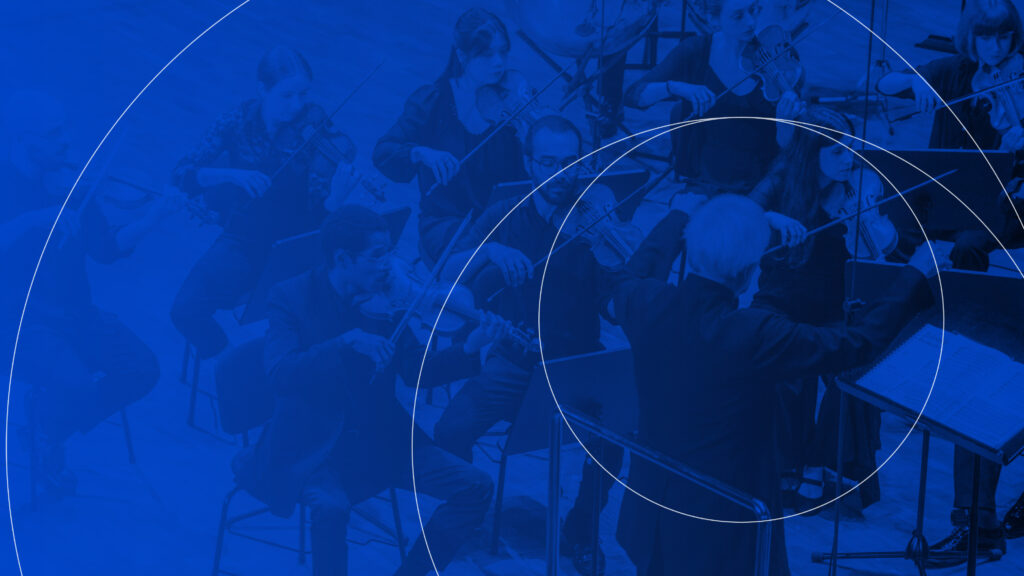
If we view the conductor as a project coordinator, the musicians as international partners, the instruments as different forms of expertise and the purpose as a common direction, what can we learn from orchestral work about achieving a common result? How does this translate into the orchestra’s daily practice?
It teaches us that a common outcome needs direction but can only be achieved through distributed responsibility. The conductor gives orientation and coherence, yet the result takes shape only when each musician assumes an active and conscious role within the whole. What orchestral work shows very clearly is that leadership is essential, but it is never sufficient on its own: a vision becomes real only when it is carried collectively. This is especially visible in the orchestras supported by ICONS. Both Theresia and EUBO are built around artistic growth and mutual responsibility, so the ensemble is sustained from within. In that sense, orchestral practice offers a compelling model of collective construction: an outcome shaped by guidance, participation and mutual accountability. In EUBO, this is reinforced by the fact that each cohort participates for one cycle only, so cohesion, roles and balance must be rebuilt every year from the beginning.
The quality of the outcome depends not only on individual talent, but also on the way the process is structured: selection, active listening, responsiveness and adaptability. Could this also be what makes the orchestra such an effective metaphor for the European project?
Absolutely. The orchestra is such a powerful metaphor for the European project because harmony is built through a carefully designed process. In ICONS’ orchestras, excellence emerges from a structured artistic and educational model, where individual talent is developed through collective work: advanced training, mobility, artistic guidance and real performance opportunities all contribute to the quality of the result. This is particularly important for young musicians, whose development depends not only on technical mastery, but also on listening, adaptability and collective awareness. EUBO is a clear example. The orchestra is entirely renewed each year, bringing together musicians who live across Europe and come from different backgrounds. This takes place within a model built around repeated residencies in different European locations, supported by a wide network of EU partners. Within this framework, quality is shaped through interactive auditions, criteria that consider technical performance alongside participation and responsiveness, and an intensive residential format in which musicians must quickly learn how to listen, adapt and build coherence together. The focus on Baroque repertoire and historically informed performance on period instruments also plays an important role, because it requires close listening, shared interpretation and constant collective adjustment. That is precisely what makes the orchestra such an effective metaphor for the European project: quality depends on how the process is designed, organised and sustained.
How significant is it that EUBO’s opening concert takes place on 9 May, Europe Day, a date that so strongly evokes the idea of Europe as collaboration, dialogue, and a shared project?
This is highly significant, because it highlights something intrinsic to EUBO itself: its European nature. Founded in the context of the European Year of Music in 1985, EUBO has always embodied Europe as a concrete practice of exchange, mobility and dialogue. Its European character is built into its structure: musicians come from across the continent, the orchestra has no fixed base, and its activity unfolds through movement between countries and residencies embedded in different local contexts. Over the years, this has taken shape across Europe and through international tours and outreach initiatives, from South Africa and Botswana in 1996 to concerts and workshops in Damascus, Ramallah and Gaza in 1997, showing how music can carry European values into very different contexts.
From this perspective, EUBO’s role as Cultural Ambassador for the European Union takes on particular relevance. At a time when young people need strong, embodied experiences of community, EUBO offers exactly that: a space where artists from different countries, backgrounds and traditions build a common language through listening and collective responsibility. That is why the 9 May concert is more than the opening of a season: it’s an opportunity to express a shared idea of Europe through music.
What happens when individual talents come together to create collective harmony?
Something that goes beyond performance takes shape: a community emerges. At EUBO, musicians who have often never met before are required to prepare a high-level performance in just a few days. Because they are at an early stage of their professional development, this experience becomes especially formative: it asks them to combine artistic excellence, flexibility and a sense of purpose in a very short time. This intense process creates cohesion rapidly. Harmony becomes a tangible experience of living and working together. This was also reflected in a workshop on the democratic dimensions of EUBO we recently held, where musicians emphasised themes such as equality across diverse backgrounds and music as a shared expression capable of giving voice to a plurality of perspectives. In this sense, harmony is not only an artistic achievement, but a practical way of coexisting, collaborating, and giving shape to Europe.