New project EUROASIS sets out to make European cities resilient to extreme heat
Press Release -
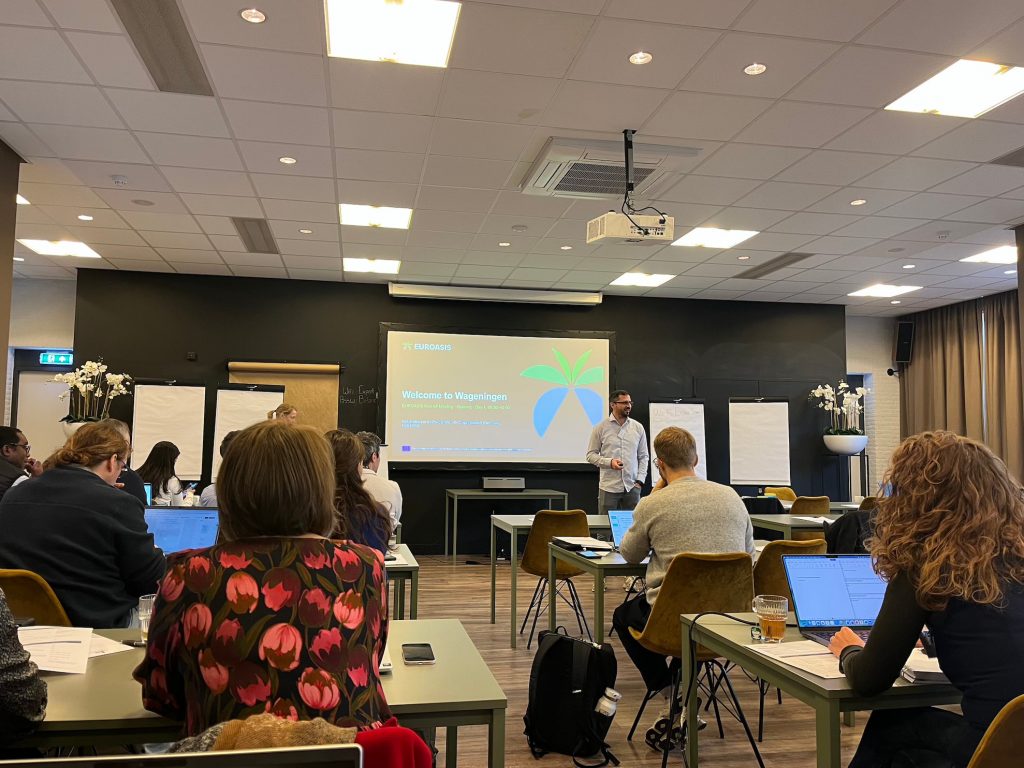
Coordinated by Wageningen University (Netherlands), the new EU-funded project will co-design, test and replicate 24 solutions for heat resilience in 11 European cities and regions over the next four years. Partners met in Wageningen on 2–4 November for the project's kick-off.
EUROASIS, a new EU-funded project led by the University of Wageningen, sets out to tackle the challenge of climate adaptation. It aims to help regional and local authorities anticipate, manage and recover from extreme heat, with a focus on protecting people’s health and well-being.
Extreme heat is the most urgent climate hazard for human health in Europe. The European Environment Agency estimates that between 60,000 and 70,000 premature deaths in Europe in 2022 were linked to heat. The people most exposed, such as older adults, children, outdoor workers, low-income households and migrants, are often the ones with the least say in how their city prepares for the next heatwave.
EUROASIS’ approach
While existing measures against heat are often planned in isolation, EUROASIS combines 24 innovations across six domains: physical, nature-based, social, digital, financial and methodological. These solutions, designed to work together, include climate shelters, an urban heat digital twin that predicts heat hotspots, new financial instruments for adaptation.
The solutions will be tested in four pilot cities: Amsterdam – the Netherlands (heat shelters, cool spots and shaded routes), Athens – Greece (protection of outdoor workers), Zaragoza and the Aragon region – Spain (nature-based solutions) and Reggio Emilia – Italy (participatory heat planning and social climate shelters). Seven replicator areas across Europe will take part from the start and adapt the solutions that prove effective.
People most affected by heat will help design the solutions through community labs supported by local mediators, with the aim of recruiting at least 30% of participants in each city from vulnerable or marginalised groups. EUROASIS will also explore new ways to finance heat resilience, such as city cooling funds, blended finance and climate budget tagging, so that local authorities can keep the measures going after the project ends.
“Heat is already reshaping how Europeans live, work and move through their cities.” – says Dragan Milosevic, Assistant Professor of Urban Hydrometeorology at Wageningen University, and EUROASIS project coordinator. “With this project, we want to take climate adaptation to the next level. Developing and testing systemic solutions, ready-to-go actions and the finance to scale them, we can build cities where every citizen is protected, and where resilience becomes part of everyday life.”

The project’s first steps
The EUROASIS partners met in Wageningen on 2–4 November 2026 to present the 24 innovations, match each pilot with the replicator areas, and meet representatives of the European Commission. This first meeting closed with a field day in Amsterdam, where the Municipality representatives showed partners local projects on heat resilience.
The first 18 months of the project will be dedicated to the preparation phase. Each pilot city will set up a resilience action lab, bringing together municipal departments, agencies, businesses, communities and experts to co-design heat measures, while pilot and replicator cities will start exchanging knowledge on governance and planning. Training on planning and climate finance will help cities develop at least three finance-ready heat resilience projects.
ICONS’ role
Within EUROASIS, ICONS Foundation leads the project’s activities on Communication, Dissemination and Exploitation (CDE), developing strategies to raise its profile among stakeholders. It also leads the work on Innovative Funding Schemes, collaborating with ICLEI to develop financing models that can sustain heat-resilience solutions beyond the project’s lifetime.
In the scaling phase, ICONS leads the co-development of investment-ready Heat Resilience Action Plans for replicator cities, as well as business modelling within the project’s capacity-building activities. This work will help other cities and regions adopt and scale up the solutions tested in the pilots.
ICONS also supports the project’s social innovation activities, led by VUB, with a focus on societal engagement. Its contributions include co-creation workshops across all cities to explore future scenarios for healthy, heat-resilient urban areas, guidelines for community labs where citizens and expert users co-design more resilient and inclusive urban spaces, and strategies to involve vulnerable and marginalised groups. In the pilot cities, ICONS helps establish Resilience Action Labs, bringing together municipal departments, agencies, industry, communities and experts to co-design heat mitigation measures. It also contributes to the feasibility study on replicating Reggio Emilia’s Social Climate Shelter in other cities.
“Heat resilience is also about how solutions are financed, adopted and scaled.” – Sated Sofia Finzi, ICONS Project Management Officer. “We will design and validate innovative funding models for heat resilience and prepare bankable business cases for the project’s flagship solutions. Just as importantly, we will help define strategies to engage people and communities in all EUROASIS cities. Finally, we’ll inform people and share knowledge through broad and targeted channels and formats”.
About EUROASIS
EUROASIS (European Adaptive, Systemic and Inclusive Solutions for heat resilience) started on 1 October 2026 and will run for 48 months. It is funded by the European Union’s Horizon Europe programme under the EU Mission on Adaptation to Climate Change, with an EU contribution of almost €10 million. The consortium, coordinated by Wageningen University (the Netherlands), brings together 29 partners from 13 countries.
Follow EUROASIS on LinkedIn. #EUROASIS
Contacts
Project coordinator:
Dragan Milosevic, Wageningen University – dragan.milosevic@wur.nl
Communication:
Federica Fusco, ICONS – federica.fusco@icons.it
Sara Antonicelli, ICONS – sara.antonicelli@icons.it