Building evidence for a more inclusive construction sector
Impact stories -
How we use social research to understand the human side of technological change — and turn evidence into knowledge people can use.
A fast-changing sector
Europe’s construction sector is changing fast, and not just because of new technology. There are fewer workers entering the industry, the workforce is getting older and women remain significantly under-represented. At the same time, construction needs to become safer, more sustainable and more attractive to a new generation of workers.
New technologies could help with all of this. But here’s the thing: knowing that a technology works doesn’t tell us whether it actually makes things better for the people using it. Does it make their day-to-day safer? Does it improve their wellbeing? Does it open the door for people who’ve traditionally been shut out of the sector?
These are the questions we care about. Not just “Does the tech function?”, but “What does it actually change for people, organisations and society?”.
From clever tech to real human impact
We put this thinking into practice through BEEYONDERS, a Horizon Europe project bringing together 21 partners across nine countries, all working to build and test worker-friendly technologies on real construction sites.
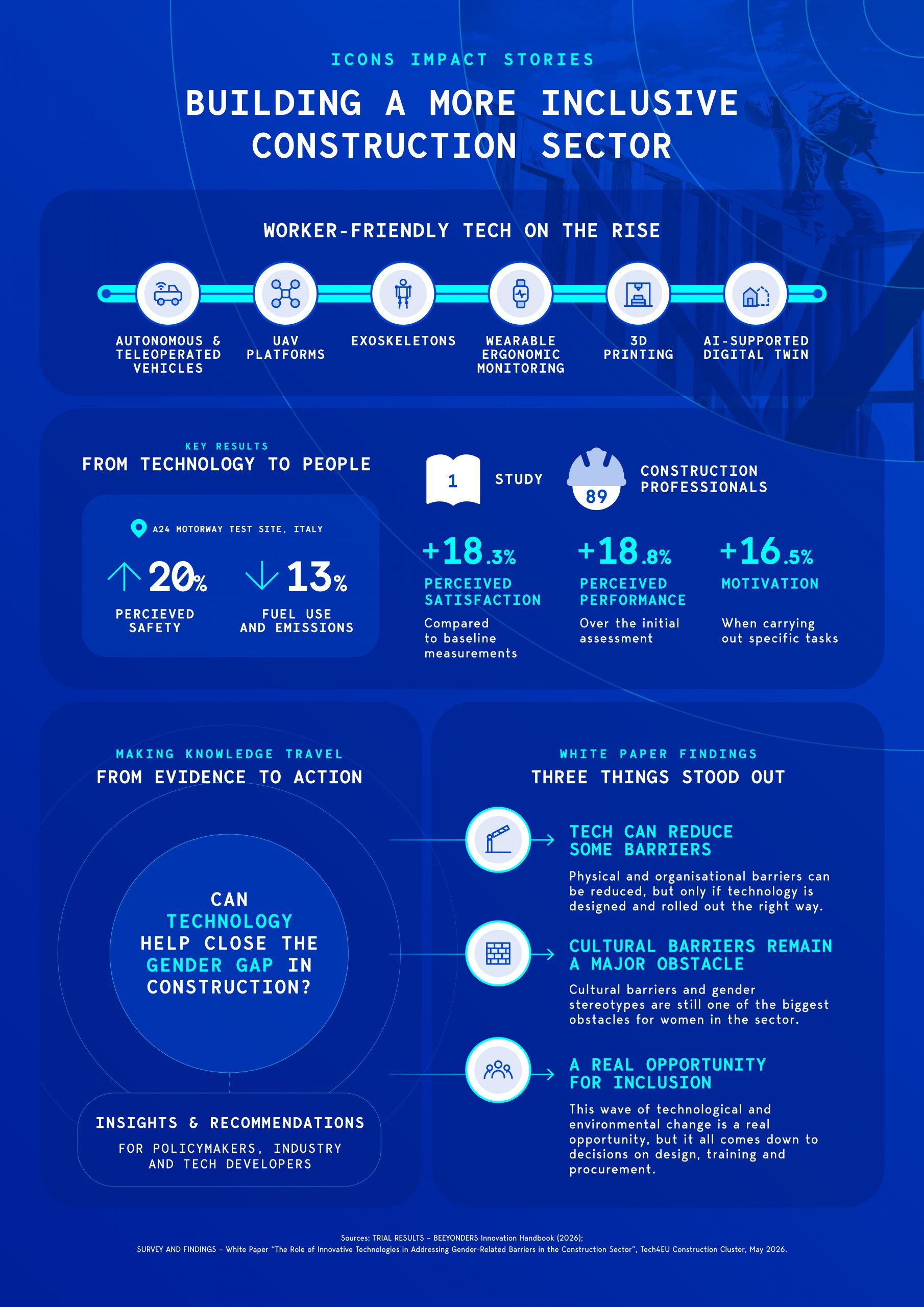
And we’re talking about a pretty wide range of technologies: from autonomous and teleoperated vehicles and UAV platforms to exoskeletons, wearable ergonomic monitoring devices, 3D printing and an AI-supported digital twin.
With all these innovations entering real working environments, we focused on the people experiencing that change first-hand. Our Social Innovation team tracked effects on health, safety, wellbeing, how work was organised, performance, and how willing people were to actually adopt the tech — using assessment models built specifically for human-robot collaboration.
And the results were genuinely encouraging. Across real-world trials, we saw:
- +18.3% in how satisfied workers felt
- +18.8% in performance
- +16.5% in motivation
At the A24 motorway in Italy, test site specifically, perceived safety went up by 20%, and fuel use and emissions dropped by 13%.
Put together, this gave us a much richer picture than “Does the tech work or not?” — it showed us what actually helps (or hinders) people in accepting and adopting new tools on site.
Making knowledge travel further
For us, generating evidence is only part of the process. Knowledge becomes more valuable when it can travel — across projects, disciplines and organisations. That’s why we connected BEEYONDERS with InCUBE, RoBétArmé and HumanTech through the Tech4EU Construction Cluster.
That gave us the chance to zoom out from any single project and ask a bigger question that matters for the whole sector:
Can these emerging construction technologies actually help break down gender-related barriers and make the industry more inclusive for women?
We led the collaborative research behind this, which became the white paper “The Role of Innovative Technologies in Addressing Gender-Related Barriers in the Construction Sector.”
What we found
We didn’t want the white paper to just report results — we wanted it to actually help people make better decisions, whether they’re policymakers, companies or tech developers.
So we shaped the research question, pulled together existing research with evidence from all four projects, built and ran a common questionnaire, and gathered input from 89 construction professionals. Then we analysed it all.
Three things stood out:
- Tech can reduce some physical and organisational barriers — but only if it’s designed and rolled out the right way.
- Cultural barriers and gender stereotypes are still one of the biggest obstacles for women in the sector.
- This wave of technological and environmental change is a real opportunity for inclusion — but it all comes down to decisions on design, training and procurement.
We then turned the findings into practical insights and recommendations, shaping the white paper from analysis all the way through to something policymakers and industry could actually pick up and use.
Why it matters
What this work really shows is that you can’t separate technological change from its human and social side. The two are closely connected.
Through impact assessment, hands-on social research, communication and Europe-wide collaboration, we helped turn technical experiments into real evidence about how innovation can make working environments safer, more attractive and potentially more inclusive.
That’s the approach we bring to research and innovation more broadly: understanding how innovation actually affects people, turning evidence into knowledge others can use, and connecting insights that would otherwise stay locked inside individual projects.
The white paper is one concrete result of that work. But the bigger value lies in the connections it created: between technology and people, between individual projects and shared knowledge, and between research evidence and the decisions still to come.
At the end of the day, our job is to help knowledge travel: beyond individual projects, across organisations and into the places where it can actually make a difference.
Read the full White Paper
Partner perspective
“Working with ICONS on the BEEYONDERS white paper was a truly rewarding experience. Their professionalism, responsiveness and collaborative spirit made it possible to bring together contributions from different projects into a coherent and impactful publication, demonstrating how effective teamwork can translate complex ideas into meaningful outcomes. ICONS consistently demonstrated an exceptional ability to facilitate collaboration across partners, ensuring that every contribution was effectively reflected in the final publication.”
Antonio Alonso Cepeda, Innovation Manager, ACCIONA, BEEYONDERS Coordinator